
Immigration Update – July 01, 2026
Headlines:
Supreme Court Increases Re-Entry Risks for Green Card Holders With Criminal History – The Court ruled 6-3 that border officers do not need clear and convincing evidence of a crime at the time of re-entry to reclassify a returning green card holder as applying for admission for the first time.
Supreme Court Rules That Trump Administration Can Proceed With Termination of TPS for Haiti and Syria – The Court held that the Temporary Protected Status statute bars judicial review of non-constitutional claims.
Court of Appeals Rules That DHS Can Apply Expedited Removal Inside the United States – The court ruled that the Department of Homeland Security’s policy is lawful and rejected a partial stay decision by a lower court and a claim by plaintiffs that the policy violates the Due Process Clause of the U.S. Constitution.
Federal Judge Blocks ICE From Arresting Noncitizens at Immigration Courts – A federal judge blocked U.S. Immigration and Customs Enforcement from arresting noncitizens at immigration courts and struck down its 12-hour-detention waiver.
DHS Proposes to Raise Naturalization Fees and End Reduced-Fee Option and Fee Waivers – The Department of Homeland Security issued a proposed rule to increase naturalization fees, end a reduced-fee option (except for qualified current and former armed forces service members), and end the availability of fee waivers.
Warning: Fake USCIS Web Pages – Practitioners are warning U.S. Citizenship and Immigration Services (USCIS) users about fake web pages that may pop up when a person is navigating to or within the USCIS website.
Details:
Supreme Court Increases Re-Entry Risks for Green Card Holders With Criminal History
On June 23, 2026, the Supreme Court decided Blanche v. Lau, a case about the rights of green card holders when they return to the United States after a trip abroad. The case involved a green card holder who was returning from overseas with a pending criminal charge. A border officer used that pending charge to reclassify him as someone applying for admission for the first time. That reclassification changed which legal rules applied to him and put him at risk of removal.
The Court ruled 6-3 that border officers do not need clear and convincing evidence of a crime at the time of re-entry to reclassify a returning green card holder this way. The government can use evidence gathered later, including a conviction that happens after the person has already re-entered, to justify the reclassification, making removal and loss of green card status more likely.
This ruling is relevant only to green card holders who:
- Have a pending criminal charge or are under investigation;
- Have a prior arrest or conviction, even for a minor offense or one that is old or resolved; or
- Are currently facing any allegation of criminal conduct.
Such a change in status can lead to loss of procedural protections, including who bears the burden of proof in any removal proceeding, confiscation of a person’s physical green card and, in some cases, mandatory detention with no right to a bond hearing.
Supreme Court Rules That Trump Administration Can Proceed With Termination of TPS for Haiti and Syria
On June 25, 2026, the Supreme Court ruled in Mullin v. Doe that the Trump administration can proceed with termination of Temporary Protected Status (TPS) for Haiti and Syria during litigation. The Court reversed the related lower court injunctions and by its holding also instructed federal courts to limit their future review of TPS terminations. Practitioners warned of the near-term implications for all TPS holders from countries whose designations have been terminated during the Trump administration.
The Court held that the TPS statute bars judicial review of non-constitutional claims, and that plaintiffs were “unlikely to prove that race was a motivating factor in the decision to terminate Haiti’s TPS designation, and it follows that they are not entitled to interim relief on their equal protection claim.”
Justice Elena Kagan’s dissent noted, among other things, that “the TPS statute mandates that [the Department of State] also advise on…whether, since an earlier TPS designation, the conditions in a country (here, Haiti and Syria) have become safe. The State Department did not do that here, so the Secretary did not fulfill her consultation requirement.” She also pointed out that “the majority claims to see no evidence that race played any role in the Haiti decision. But the evidence is there, plain to see, in the President’s statements, which the majority (and for that matter, his own lawyers) cannot even bear to repeat. Once that much is established, the case for interim relief is made: There is no dispute that the plaintiffs will suffer irreparable harm absent postponement of the TPS decisions. So the plaintiffs are entitled to stay in this country while these suits go forward.”
The American Immigration Lawyers Association (AILA) said in a statement that it was “deeply alarmed” by the ruling and that it “undermines national and economic interests.” AILA President Jeff Joseph said, “Even the Department of State says that no part of Syria is safe, and has issued security advisories due to unrest in Haiti. Conditions are likely to remain so for the foreseeable future. Yet, the Supreme Court’s decision today could force these individuals back to these devastating conditions in a matter of days. It also allows the Administration to arbitrarily terminate all other TPS designations with impunity going forward.”
Benjamin Johnson, AILA Executive Director, said, “I want every member of Congress to look around their community and state, to listen to employers and residents about what harm will come if TPS holders are forced back to dangerous conditions and removed from the communities they have become integral to.”
Haitian and Syrian TPS holders’ work authorization is set to expire on Wednesday, July 1, 2026. The ruling is likely to accelerate the resolution of pending challenges to the administration’s decisions to end work authorization and status for other TPS-designated countries. As such, others with TPS also likely will see their work authorization end in the coming weeks and months.
Court of Appeals Rules That DHS Can Apply Expedited Removal Inside the United States
On June 23, 2026, the U.S. Court of Appeals for the District of Columbia ruled 2-1 in Make the Road New York v. Markwayne Mullin that the Department of Homeland Security (DHS) can apply expedited removal nationwide to “certain aliens who cannot demonstrate continuous physical presence in the United States for at least two years.”
According to the majority, DHS may follow its policy to place in expedited removal, with limited exceptions, those who are inadmissible “because they lack valid documentation or entered via fraud or willful misrepresentation, have not been admitted or paroled, and have not affirmatively shown, to the satisfaction of an immigration officer, that they have been continuously present in the United States for the two years immediately preceding the determination of inadmissibility.” The majority rejected a partial stay decision by the lower court and a claim by plaintiffs that the policy violates the Due Process Clause of the U.S. Constitution.
Circuit Judge Wilkins, dissenting in part, noted that the fact that the procedures implementing the DHS policy “do not require (1) DHS to ask the persons when they entered the country, or (2) DHS to advise persons that expedited removal applies only if the person has not been continuously present in the country for two years, violates due process.” A procedure “that can result in persons being deported pursuant to the expedited removal statute without even being asked how long they have been in the country might satisfy due process for persons encountered at the border, but it is woefully inadequate for persons encountered in the interior of the country,” he said.
Federal Judge Blocks ICE From Arresting Noncitizens at Immigration Courts
On June 23, 2026, a federal judge in the U.S. District Court for the Northern District of California blocked U.S. Immigration and Customs Enforcement (ICE) from arresting noncitizens at immigration courts and struck down ICE’s 12-hour-detention waiver.
“It is now clear that the lack of connection between ICE’s stated rationales for the 2025 courthouse-arrest policies and the expansion of arrests at immigration courthouses results not from merely unreasoned decision-making but a complete lack of decision-making,” U.S. District Judge P. Casey Pitts said. He explained, “For 80 years, Congress has commanded federal agencies to think before they act. That instruction—codified in the [Administrative Procedure Act (APA)]—does not require an agency to make the choice that a reviewing court might deem preferable. But it demands that an agency at least provide sound reasons for following its chosen course.” Judge Pitts concluded that “each of the challenged policies is arbitrary and capricious in contravention of the APA.”
DHS Proposes to Raise Naturalization Fees and End Reduced-Fee Option and Fee Waivers
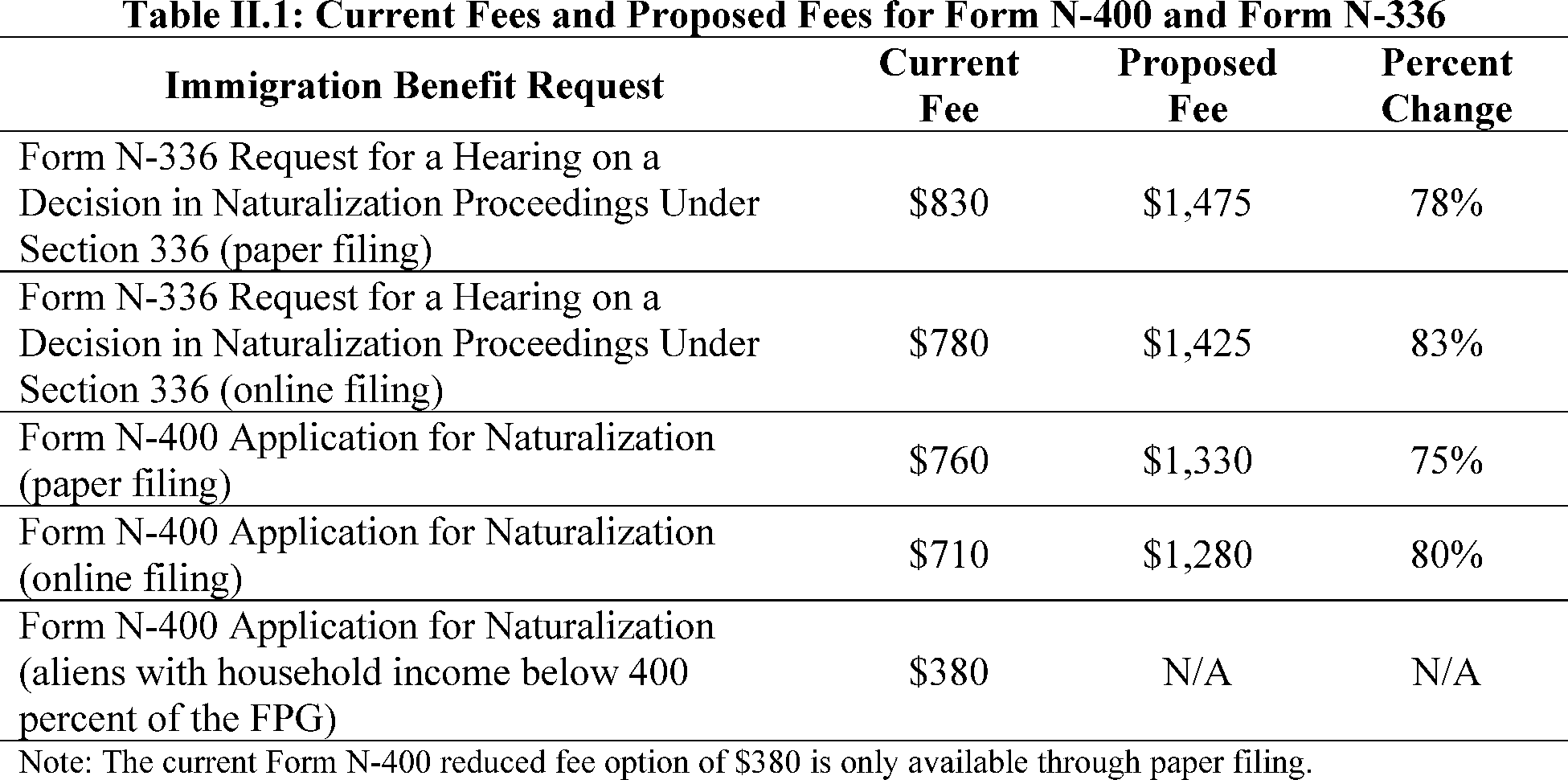
On June 23, 2026, the Department of Homeland Security (DHS) issued a proposed rule to increase naturalization fees, end a reduced-fee option (except for qualified current and former armed forces service members), and end the availability of fee waivers.
The proposed rule summarized the fee changes in the table below:
Warning: Fake USCIS Web Pages
Practitioners are warning U.S. Citizenship and Immigration Services (USCIS) users about fake web pages that may pop up when a person is navigating to or within the USCIS website. The pages look real at first glance but include misinformation and an incorrect URL and logo.
The official USCIS website is at https://www.uscis.gov/. Below is a screenshot example of a fake page URL:






Leave a Reply
Want to join the discussion?Feel free to contribute!